Protocols
The queue
Where a play becomes somebody's next task: what an engagement card carries, the states it moves through, and why the desk never gets buried.
最后更新
Who this is for: anyone holding
protocols.engagement.read— typically Front Desk, Manager and Owner. Where: Protocols → Queue
A play that fires produces an engagement: one protocol, one target, one moment, one assignee. The queue is where those land and where they get worked.
This is the surface the whole module exists to serve. A play nobody acts on is a note in a database.
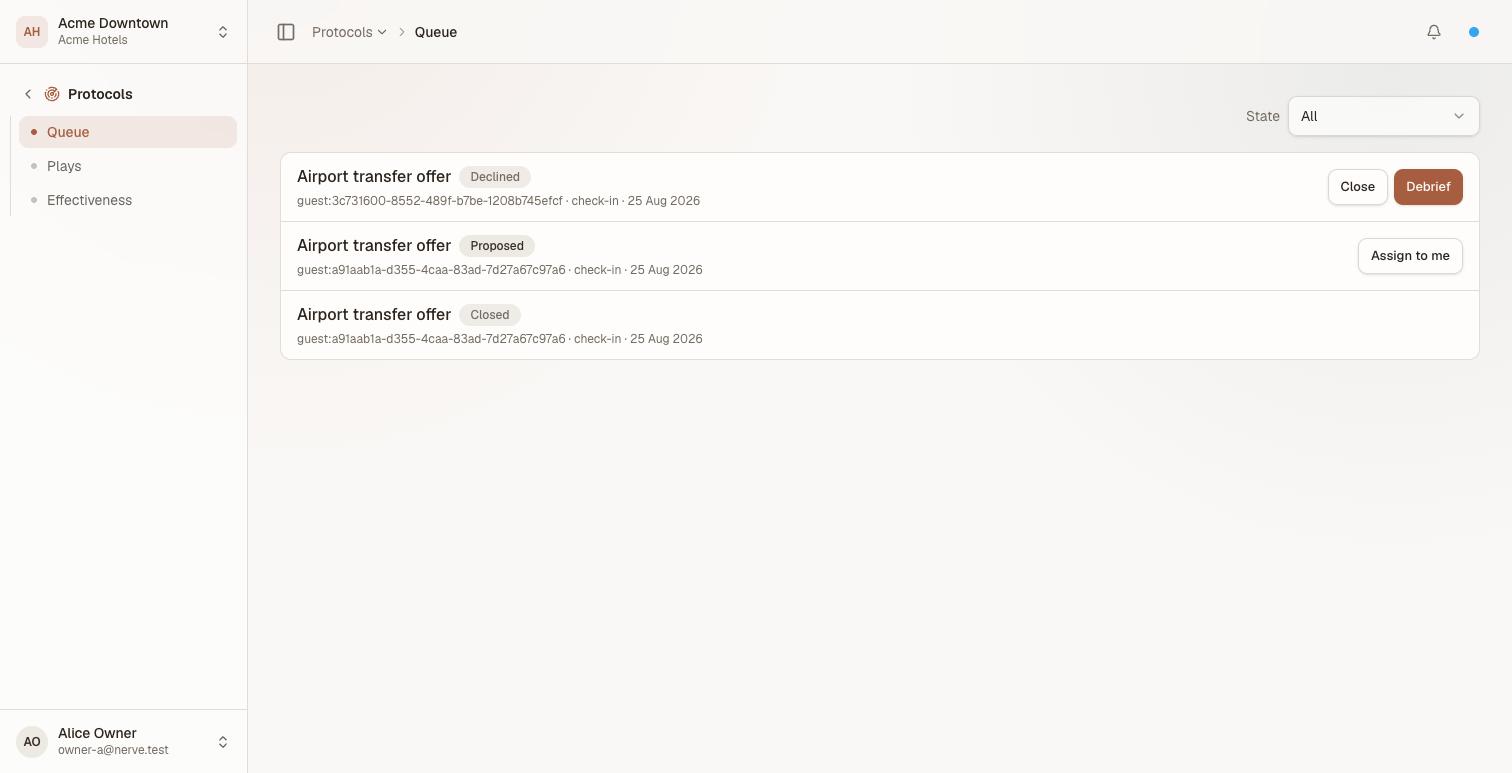
Three engagements from the same play, in three different states. The actions follow the state — a proposed one offers Assign to me, an acted one offers Debrief — and declined sits in the list as a finished answer rather than disappearing.
What a card carries#
An engagement is not a notification. It is a card with everything needed to act without going and looking things up:
| On the card | What it is for |
|---|---|
| Instruction | What to do, in the words the play author wrote |
| Script | The suggested phrasing, where the play has one |
| Why | The reason this fired, in a sentence |
| Evidence | The facts behind the why — inspectable, not a summary |
| Debrief | The question you will be asked afterwards, visible before you act |
| Authority envelope | What you may offer without asking anyone |
| Expires | When this moment stops being the moment |
The envelope being on the card is the point. A front-desk agent should not have to guess whether they are allowed to comp the breakfast — the card says what they may do, and going beyond it is an escalation, which is a recorded transition rather than a workaround.
Showing the debrief question before the action is also deliberate. Knowing you will be asked "did they take the upgrade?" changes how you make the offer.
The states#
| State | Meaning |
|---|---|
| Proposed | Fired, waiting for someone to pick it up |
| Assigned | Claimed — it is yours |
| Acted | You did the thing; the debrief is now owed |
| Declined | You judged it not to apply, with a reason |
| Debriefed | The question is answered and its projection has been applied |
| Closed | Finished |
| Expired | The moment passed before anyone acted |
The actions on a card follow the state: Assign to me, then Act or Decline, then Debrief, then Close. Filter by state from the header; All shows everything.
Declining is a real answer, not a failure. A play that fires on stays it should not is only discoverable if people are able to say so cheaply, and a decline with a reason is the signal that finds it. So is a run of expiries: it usually means the trigger is firing at the wrong moment rather than that the team is ignoring the queue.
Why the desk does not get buried#
A trigger flood — a hundred bookings landing at once, a badly-scoped signal — could bury a front desk under prompts and make the whole surface something people learn to ignore. So new engagements are throttled: at most five new proposals per role, per property, in a rolling hour.
Engagements that are already assigned keep delivering past that cap. It is only proposing more work that backs off. The intent is that the queue stays a place a person can actually clear.
Claiming is atomic#
Two people opening the queue at the same moment cannot both take the same engagement — the claim is settled server-side, and the second one is told it is already taken rather than being allowed to do the work twice. The same holds for an agent working the queue through list_engagements and submit_debrief: it claims through the identical path, under the identical permissions.
The debrief writes exactly one thing#
When you answer, the play's projection applies the change that answer implies to the target record — and nothing else. The change is caused (it points back at the engagement that produced it) and reversible.
There is no path from a debrief to an arbitrary field edit, and none from a model to a write. If you want a play to be able to change something, that change has to be declared in the play's projection first, by a person, in advance.
What's next#
- Authoring plays — where instructions, envelopes and debriefs are written.
- Governance — suppressing a guest, and the ceilings an envelope cannot exceed.
- Effectiveness — what all this debriefing is measuring.